Common Designs of Magnetic Rods and Magnetic Field Distribution Simulation
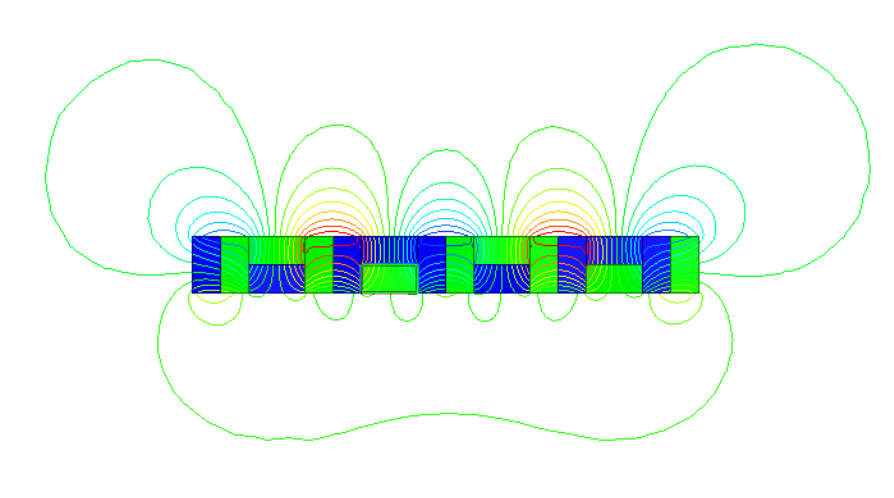
Magnetic rods typically have three common arrangement structures: parallel attraction, conventional arrangement (repulsion), and Halbach array.
1. Parallel Attraction:
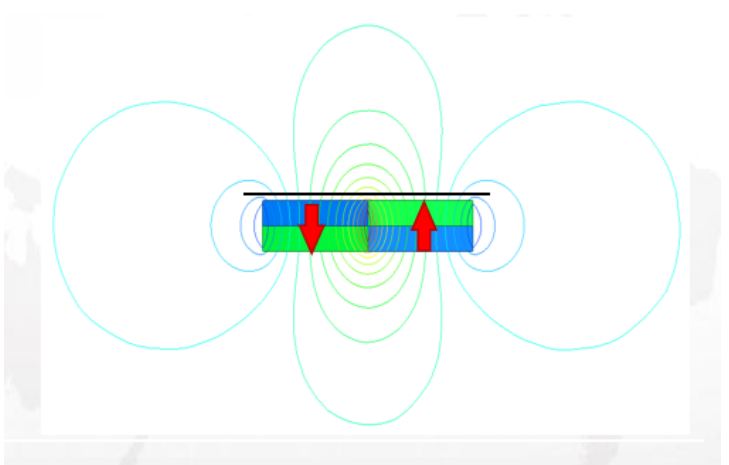
In this design, adjacent magnets have the same polarity on their sides, causing them to attract each other. This structure is relatively simple to assemble but lacks the magnetic concentration effect created by repulsion. The surface magnetic field is weaker, and the overall working magnetic field is more limited.
In a parallel attraction arrangement, adjacent polarities form a circuit close to each other, reducing the extension of the magnetic field into space. This arrangement increases magnetic field intensity within the region, enhancing surface magnetism. Simulation calculations show that magnetic field lines between poles disperse outward along magnetic conductors toward the nearest opposite polarity. Higher magnetic flux density is observed at the outer edge of the conductor, corresponding to stronger surface magnetism. However, the ends of the magnetic rod show weaker surface magnetism due to lower magnetic flux density.
2. Conventional Arrangement (Repulsion):
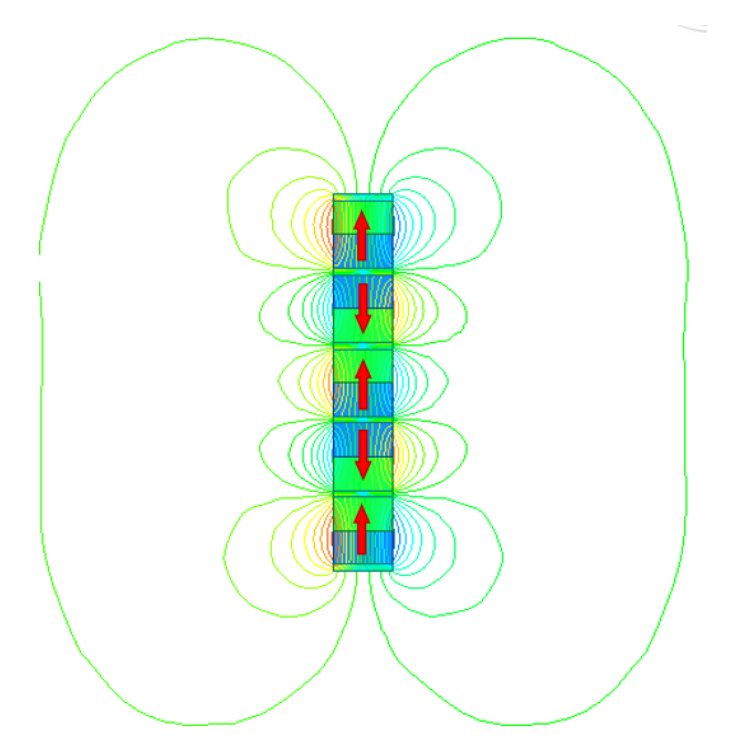
In this arrangement, adjacent magnets are arranged with the same poles repelling each other. To ensure the magnetic lines of force are transmitted to the outer surface of the magnetic rod where they are needed, a magnetic conductor is added between the repelling poles. Simulations show that magnetic lines of force between the poles spread out along the conductor to the nearest opposite pole, creating a stronger magnetic field at the outer surface. Similar to parallel attraction, the magnetic flux density at the ends of the rod is lower, resulting in weaker surface magnetism at those points.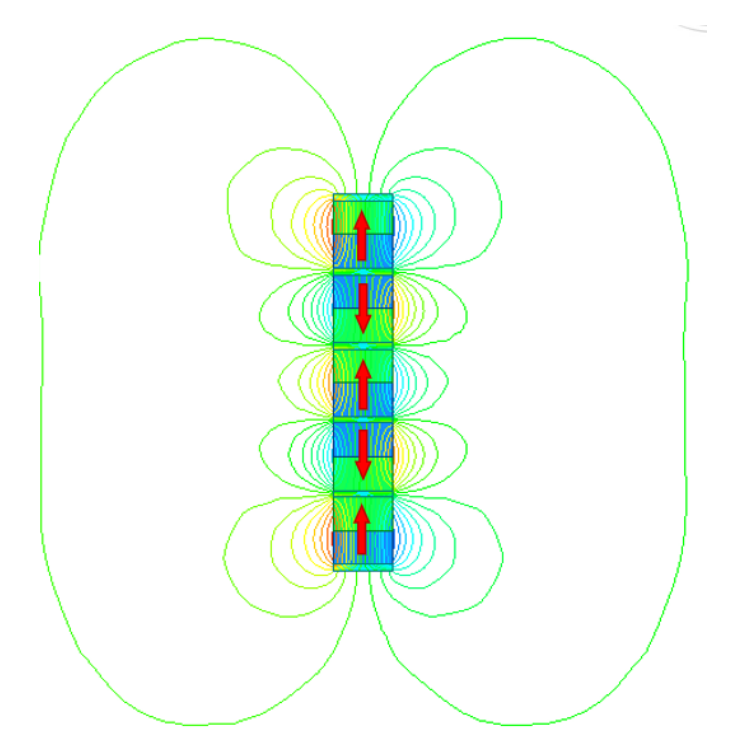
3. Halbach Array:
The Halbach array arranges adjacent magnets in a structure where half of them attract and half repel, creating a weak magnetic field on one side and a strong magnetic field on the other. The main advantage of this design is that it concentrates a relatively high magnetic field using the same amount of magnetic material, though the design requirements and production difficulty are higher.
In the Halbach arrangement, the strong magnetic surface shows a high concentration of magnetic field lines, while the weak magnetic surface has a lower concentration, maximizing the magnetic field's efficiency on the desired side.
This combination of magnetic arrangements allows magnetic rods to perform effectively in various applications, balancing assembly simplicity, magnetic field strength, and cost considerations.